
Understanding the difference between a resume and a CV is crucial for job seekers. Many applicants use these terms interchangeably, but recruiters view them differently depending on the region, industry, and type of application. Knowing when to use a resume versus a CV can increase your chances of being shortlisted and ensures you present your qualifications effectively.
What Is a Resume?
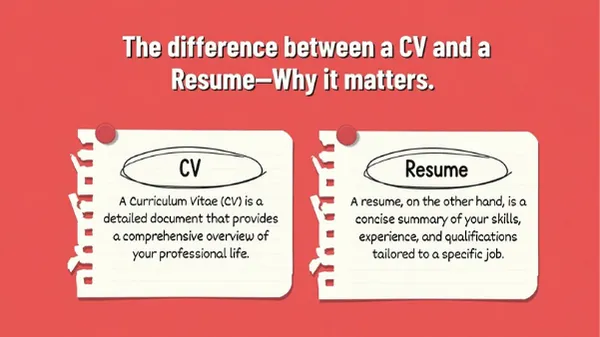
A resume is a concise, one to two-page document that summarizes your skills, education, work experience, and achievements. It is typically used in private sector jobs, corporate roles, and positions where brevity is valued. A resume is tailored to a specific job and emphasizes relevant experience and skills to match the role.
What Is a CV?
A CV, or Curriculum Vitae, is a comprehensive document that details your entire career journey. It includes education, work experience, research, publications, awards, certifications, and sometimes personal interests. CVs are often required in academia, research, and international job applications, and there is no strict length limit.
Key Differences Between Resume and CV
| Feature | Resume | CV |
|---|---|---|
| Length | 1–2 pages | Multiple pages depending on experience |
| Purpose | Job-specific, highlights relevant skills | Complete career overview |
| Customization | Tailored to each job application | Usually standard, updated over time |
| Usage | Corporate jobs, private sector positions | Academic, research, international roles |
| Detail Level | Concise and focused | Detailed with publications and awards |
| ATS Optimization | Focus on keywords from job description | Keywords less emphasized |
When to Use a Resume vs CV
Use a resume when applying for private sector or corporate jobs, internships, or roles where brevity and clarity are preferred. Use a CV for academic positions, research roles, fellowships, international applications, or when a detailed career history is required. In countries like the US and Canada, resumes are more common for corporate jobs, while CVs are used for academia and research.
Tips for Writing Both
Focus on clarity, accuracy, and relevance. Use standard headings like “Education,” “Skills,” and “Experience.” Tailor resumes to the job description and include measurable achievements. For CVs, ensure all academic achievements, publications, and certifications are accurately listed. Keep formatting simple for ATS compatibility and readability.
FAQ About Resume and CV
Q1: Can a CV be used as a resume?
A: In some cases, yes, but CVs are often longer and may include unnecessary details for corporate jobs.
Q2: How long should a resume be?
A: Ideally 1–2 pages depending on experience.
Q3: Can freshers use a CV?
A: Yes, if applying for academic or research positions; otherwise, a resume is preferred.
Q4: Is a resume better for ATS systems?
A: Yes, resumes are shorter, keyword-optimized, and easier for ATS to parse.
Conclusion
Choosing between a resume and CV depends on the job type, industry, and region. Resumes are concise, tailored, and suitable for corporate jobs, while CVs provide a comprehensive record of your career for academia and research. Understanding these differences ensures your application aligns with recruiter expectations and increases the likelihood of being shortlisted in 2026.
Disclaimer
This article provides general guidance on resumes and CVs. Requirements may vary depending on the employer, country, or industry.